
Centr Power at Home guide: Advanced Centr Power at Home guide: Advanced

Centr Team
14 Jun 2022

Welcome to Centr Power at Home: Advanced, the definitive 13-week muscle-building program designed by Chris Hemsworth and his personal trainer Luke Zocchi.
To achieve next-level results with this Advanced program, the right home equipment and adapting your nutrition will be crucial.
This program has been built around the 5 key principles of building muscle:
1. Compound movements
Multi-joint exercises that work several muscle groups at once.
2. Volume
The number of reps and sets you do, with consistency and repetition.
3. Intensity
The tempo at which you perform exercises and the time your muscles spend under tension.
4. Rest and recovery
Moderate downtime between exercises and rest between workouts to allow your muscles to repair and grow.
5. Training to failure
Challenging your muscles to the point where you can’t repeat another rep.
Why build your training around these principles? Watch as Bobby breaks it down for you.
Is Advanced the right level for me?
There are 3 levels in Centr Power at Home: Beginner, Intermediate and Advanced.
You’re ready for Advanced training if you can comfortably lift the equivalent of your bodyweight for multiple reps while maintaining good form. If you’re not sure, head to the Centr Power at Home FAQ.
What to expect during the program
A progressive mix of exercises and sets designed to push your muscles to failure will challenge your body and shake up your routine. Building muscle is about consistency, so be prepared for workouts within each phase to repeat – exactly the way Luke trains Chris to get results.
Your 13 weeks of training is split into four x 3-week phases, plus 1 deload week. Each phase changes things up so your body doesn’t get comfortable or your results plateau.
Your home equipment checklist
What kind of gear do you need for Centr Power at Home: Advanced? Check out the list of equipment required below.
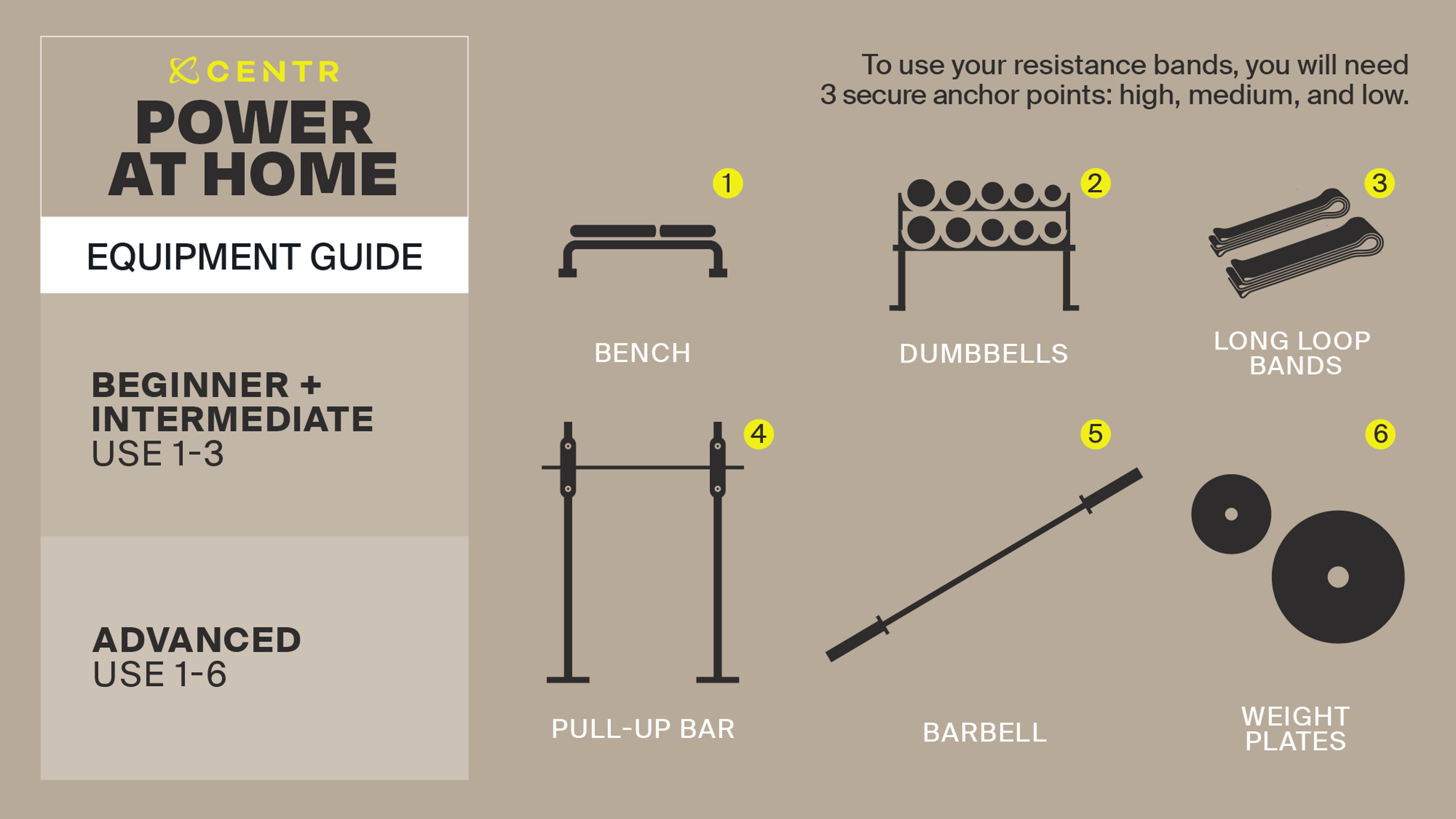
For help choosing the right resistance bands, head to our guide.
How to choose, increase and track your weights and bands
Progressive overload – increasing the intensity of your training so that your body adapts and grows stronger – is essential to getting the best results with Power.
If you’re doing the Advanced program, you should have a good grasp on weight choice. If you need a refresher, Luke and Bobby will explain how to find the weight that’s right for you.
Selecting resistance bands
Long loop bands are the best option for this program – also called power bands or pull-up bands.
- You’ll need two band strengths to get started: one lighter and one heavier.
- Just like weights, you will need to increase the resistance as you grow stronger. This may require adjusting the bands you have or investing in heavier bands.
- The exercises you’ll be doing require fixed anchor points for your bands. This can be done with something solid already in your home, or by installing anchor points.
Setting up correctly will ensure you can train safely with bands. Find the full lowdown on how to use resistance bands.
Increasing your weights and bands
- If you get through one set of the recommended reps with great form and without slowing down, it’s time to increase weight/resistance.
- The weight/resistance you’re using should make it challenging to complete your final reps regardless of the total amount of reps.
- As a general rule, increase the dumbbell weight you’re lifting by 1lb (or ½ kg) when you’re ready.
How to track your progress
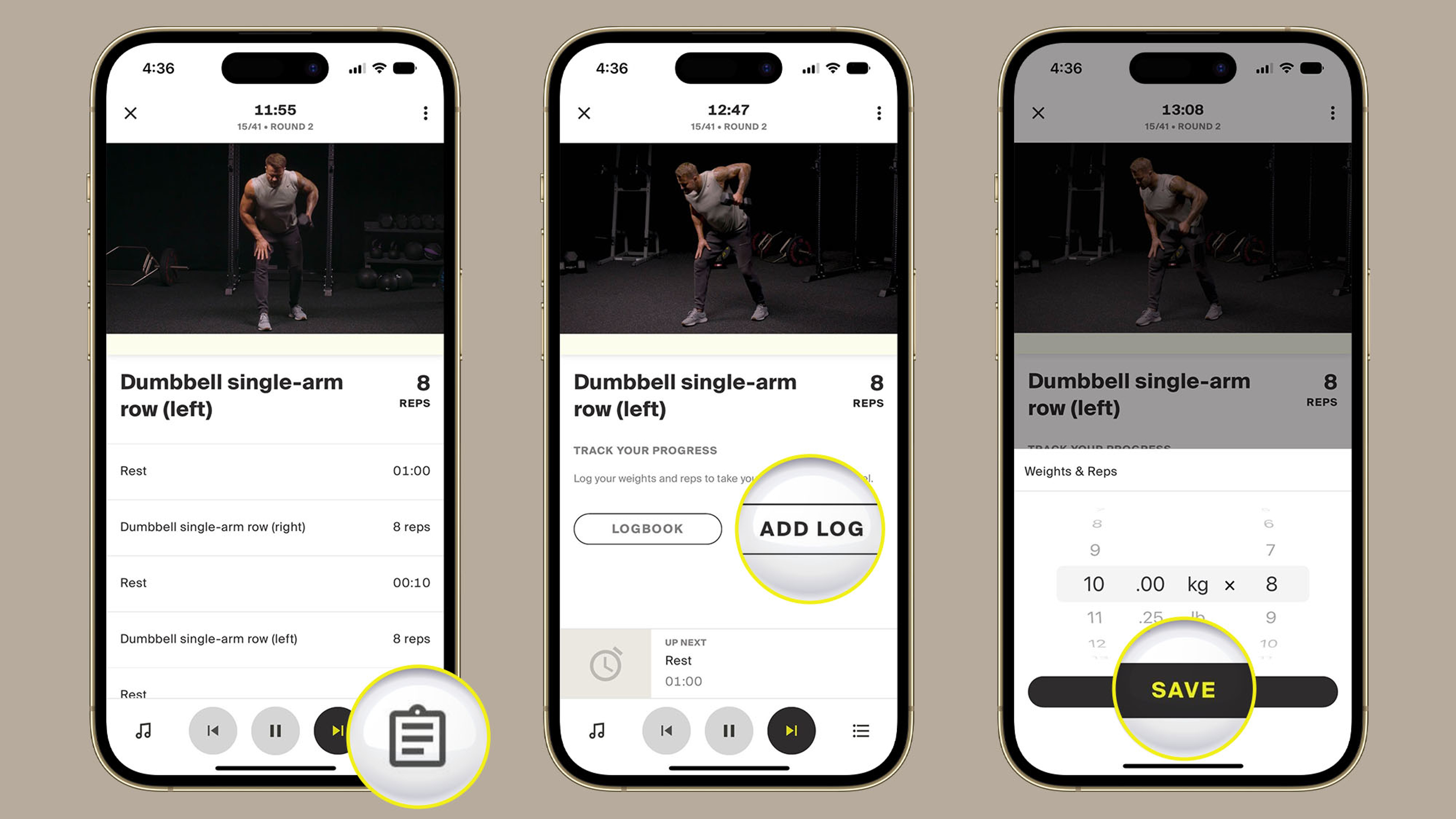
You should be getting stronger the further you get into the program. Track your dumbbell weight using the Weights Tracker feature on your workout screen – you can log your weights and reps for an exercise as you complete it during each self-guided session.
- Click the notepad icon at the bottom of your screen.
- Tap ‘Add Log’ to enter your weights and reps.
- Numbers will default to the last weight you logged and the number of reps (if any) specified in the workout.
Check out the explainer for our Weights Tracker feature to learn more about tracking your weights and reps.
Tutorials and Tempo
No matter what level you’re training at, good form and an effective tempo is vital to your muscle-building progress.
Form tutorials: Each phase of Centr Power at Home contains form videos demonstrating key moves to help you get it right. You’ll find links to the tutorials at the beginning of each week of the program and in every individual workout.
Want to start working on your technique now? You’ll find every At Home tutorial in this article – save it now so it’s easy to find when you need it.
Tempo: For most of the exercises in Centr Power at Home: Advanced, the standard tempo is 3-0-1-0. When an exercise has a different tempo it will be listed next to the exercise name. Make sure you follow the tempo as directed, and reference Bobby for form only.
Nailing your muscle-building nutrition
Your nutrition needs can change as you progress. Small tweaks can make a big difference to your performance, recovery and muscle growth. So let’s get serious about what you eat and when.
Ensure your Centr goal is set to Gain Muscle, then check out your Nutrition Handbook.
Understanding the science of gains
Muscle-building is a science. As with any science experiment, there are variables that will impact your results. Hit these links to learn more:
More questions?
If you have any other questions about Centr Power at Home that haven’t been answered, check out the FAQ.
Disclaimer: If you’re injured, diabetic, have a medical condition or a physical disability, you must consult your doctor or professional healthcare provider before starting your Centr Power journey.
Please note Centr Power is not suitable for pregnant women, nor has it been designed for postpartum or breastfeeding women.
Never attempt to lift excessive weight. If you’re unsure how to perform a move with good form or use a piece of equipment, always watch the exercise tutorials and learn how to use the equipment prior to starting.
Results will vary from person to person and are influenced by genetics, age, metabolic rate, health history and adherence to diet and training.


